<?xml version="1.0" encoding="UTF-8"?>
<!--Generated by Squarespace Site Server v5.9.2 (http://www.squarespace.com/) on Fri, 12 Mar 2010 18:53:38 GMT--><feed xmlns="http://www.w3.org/2005/Atom" xmlns:dc="http://purl.org/dc/elements/1.1/"><title>Blog</title><subtitle>Blog</subtitle><id>http://totalrecallbook.com/blog/</id><link rel="alternate" type="application/xhtml+xml" href="http://totalrecallbook.com/blog/"/><link rel="self" type="application/atom+xml" href="http://totalrecallbook.com/blog/atom.xml"/><updated>2010-03-12T15:17:48Z</updated><generator uri="http://www.squarespace.com/" version="Squarespace Site Server v5.9.2 (http://www.squarespace.com/)">Squarespace</generator><entry><title>New York Times article on SenseCam</title><category term="Memory"/><category term="Memory"/><category term="SenseCam"/><id>http://totalrecallbook.com/blog/2010/3/12/new-york-times-article-on-sensecam.html</id><link rel="alternate" type="text/html" href="http://totalrecallbook.com/blog/2010/3/12/new-york-times-article-on-sensecam.html"/><author><name>Jim Gemmell</name></author><published>2010-03-12T15:15:53Z</published><updated>2010-03-12T15:15:53Z</updated><content type="html" xml:lang="en-US"><![CDATA[<p><a href="http://www.nytimes.com/2010/03/09/health/09memory.html?hpw">A Little Black Box to Jog Failing Memory</a>, By YUDHIJIT BHATTACHARJEE, NYT, March 8, 2010.</p>
<p>A nice article on SenseCam with a focus on memory-loss applications.</p>
<blockquote>
<p>Two years ago, Mr. Reznick, who has early-stage Alzheimer&rsquo;s disease and is now 82, signed up for an experiment intended to help people with Alzheimer&rsquo;s and other memory disorders. The concept was simple: using digital pictures and audio to archive an experience like a weekend visit from the grandchildren, creating a summary of the resulting content by picking crucial images, and reviewing them periodically to awaken and strengthen the memory of the event.</p>
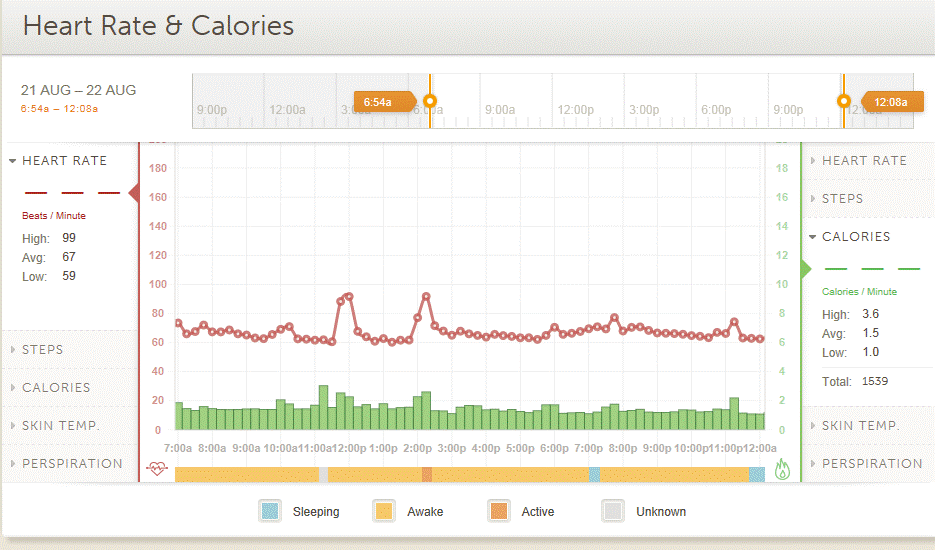
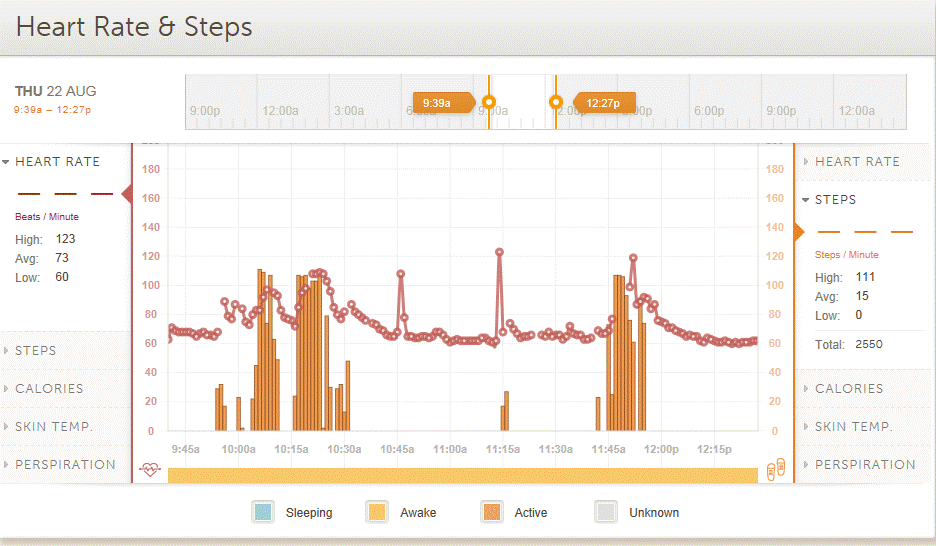
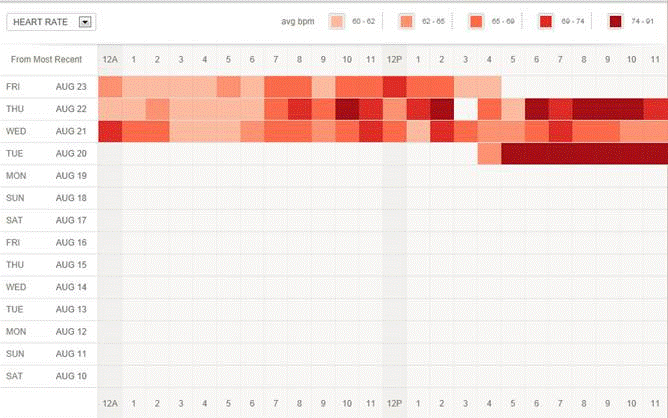
</blockquote>]]></content></entry><entry><title>Fitbit wearable fitness logging</title><category term="Health"/><category term="fitbit"/><id>http://totalrecallbook.com/blog/2010/3/6/fitbit-wearable-fitness-logging.html</id><link rel="alternate" type="text/html" href="http://totalrecallbook.com/blog/2010/3/6/fitbit-wearable-fitness-logging.html"/><author><name>Jim Gemmell</name></author><published>2010-03-06T19:34:07Z</published><updated>2010-03-06T19:34:07Z</updated><content type="html" xml:lang="en-US"><![CDATA[<p>The <a href="http://www.fitbit.com">FitBit</a>&nbsp;is yet another entry in the wearable fitness category. It uses motion-sensing to keep track of calories burned, steps taken, distance traveled and even sleep quality. It is in the form of a little clip that you can put on your waistband or pocket. It also comes with a wristband, which is recommended while sleeping. Here's a review in the <a href="http://online.wsj.com/article/SB10001424052748703740004574513582518301794.html">Wall Street Journal</a></p>
<p><span class="full-image-block ssNonEditable"><span><img src="http://totalrecallbook.squarespace.com/storage/images/fitbit.jpg?__SQUARESPACE_CACHEVERSION=1267905677807" alt="" /></span></span></p>]]></content></entry><entry><title>Sensors everywhere – even in lightbulbs</title><category term="Girton Labs"/><category term="LLyndsay Williams"/><category term="SenseBulb"/><category term="The Future"/><id>http://totalrecallbook.com/blog/2010/3/6/sensors-everywhere-even-in-lightbulbs.html</id><link rel="alternate" type="text/html" href="http://totalrecallbook.com/blog/2010/3/6/sensors-everywhere-even-in-lightbulbs.html"/><author><name>Jim Gemmell</name></author><published>2010-03-06T19:17:18Z</published><updated>2010-03-06T19:17:18Z</updated><content type="html" xml:lang="en-US"><![CDATA[<p>In Total Recall, we predict a proliferation of sensors. It seems that eventually nearly everything than can be instrumented will be. What does &ldquo;nearly everything&rdquo; include? Well, how about your lightbulbs? Lyndsay Williams, the inventor of the SenseCam, has invented the <a href="http://sites.google.com/site/girtonlabs2/sensebulb">SenseBulb</a>. This lightbulb watches over you from above, but with a view to temperature, not what is visible, as the <a href="http://news.bbc.co.uk/2/hi/technology/8235712.stm">BBC</a> explains:</p>
<blockquote>
<p>the device uses four sensors known as thermopiles - the same kind of detector found in heat-seeking missiles. They sense temperature differences accurately and over a short time from a narrow angle.</p>
</blockquote>
<p>Lindsay envisions the bulb being used for "Assisted Living&nbsp; and Alzheimer's&nbsp; patients" detecting</p>
<blockquote>
<p>...incidents in the home, e,g, a door left open, cooker unattended&nbsp; or somebody fallen in the bathroom. A text message is&nbsp; sent to a mobile phone. SenseBulb is also useful for security systems in the home and office.</p>
</blockquote>
<p>It can even notice "the cold draft from the cat flap," <a href="http://lyndsaywilliams.blogspot.com/2009/09/what-next-after-microsofts-sensecam.html">sending Lyndsay a text message when her cat goes in and out</a>.</p>
<p>Where will we find sensors next?</p>]]></content></entry><entry><title>Two wireless wearable devices for vital signs: WIN Human Recorder and Digital Plaster</title><category term="Health"/><category term="biometric"/><category term="wearable"/><category term="wireless"/><id>http://totalrecallbook.com/blog/2010/1/29/two-wireless-wearable-devices-for-vital-signs-win-human-reco.html</id><link rel="alternate" type="text/html" href="http://totalrecallbook.com/blog/2010/1/29/two-wireless-wearable-devices-for-vital-signs-win-human-reco.html"/><author><name>Jim Gemmell</name></author><published>2010-01-29T23:26:45Z</published><updated>2010-01-29T23:26:45Z</updated><content type="html" xml:lang="en-US"><![CDATA[<p>The <a href="http://techon.nikkeibp.co.jp/english/NEWS_EN/20100119/179393/">WIN Human Recorder</a>:</p>
<blockquote>
<p>a system that measures electrocardiographic signals, body surface temperature and human movements at the same time by attaching a sensor with wireless communication capability to the chest... Human movements are detected by a three-axis acceleration sensor.</p>
</blockquote>
<p><span class="full-image-block ssNonEditable"><span><img src="http://totalrecallbook.squarespace.com/storage/post-images/winHumanrRecorder.jpg?__SQUARESPACE_CACHEVERSION=1264807957571" alt="" /></span></span></p>
<p><a href="http://news.bbc.co.uk/2/hi/health/4617633.stm">Digital plaster</a>:</p>
<blockquote>
<p>An tiny electronic device, which can be attached to an ordinary plaster, has been developed by a scientist from London's Imperial College.</p>
<p>The device checks vital signs such as temperature, blood pressure and glucose levels, sending results to a computer, which highlights any cause for concern.</p>
</blockquote>
<p>Hat tip: <a href="http://singularityhub.com/2010/01/27/the-win-human-recorder-a-patch-to-monitor-your-health/">Singularity hub</a></p>
<p>&nbsp;</p>
<p>&nbsp;</p>
<p>&nbsp;</p>
<p>&nbsp;</p>
<p>&nbsp;</p>
<p>&nbsp;</p>]]></content></entry><entry><title>Total Recall for Police Officers</title><category term="Camera"/><category term="Police"/><category term="Work"/><id>http://totalrecallbook.com/blog/2010/1/23/total-recall-for-police-officers.html</id><link rel="alternate" type="text/html" href="http://totalrecallbook.com/blog/2010/1/23/total-recall-for-police-officers.html"/><author><name>Jim Gemmell</name></author><published>2010-01-23T19:20:55Z</published><updated>2010-01-23T19:20:55Z</updated><content type="html" xml:lang="en-US"><![CDATA[<p>Police in San Jose are testing <a href="http://www.foxnews.com/story/0,2933,580667,00.html?sPage=fnc/us/crime">head-mounted cameras</a>. Meanwhile&nbsp;<a href="http://www.vievu.com/">Vievu</a> is making a chest-worn "video camera for cops." <a href="http:/">Evidence.com</a>&nbsp;wants to be the storage system for cops:</p>
<blockquote>
<p>EVIDENCE.COM&trade; is a full featured system designed around easy-to-use dashboards that turn geospatial multi-media evidence, such as GPS tagged video, into visual dashboards and tactical maps with full click-through to underlying video data</p>
</blockquote>
<p>For soldiers and cops, video may be the first thing to start capturing. For the rest of us, it is probably the last, with things like health data, personal correspondence, and vacation photos being near the head of the list.</p>]]></content></entry><entry><title>Wipe The Slate Clean in 2010, use the Web 2.0 Suicide Machine</title><category term="Challenges"/><category term="MyLifeBits"/><category term="lifeblogging"/><category term="social netwoks"/><id>http://totalrecallbook.com/blog/2010/1/15/wipe-the-slate-clean-in-2010-use-the-web-20-suicide-machine.html</id><link rel="alternate" type="text/html" href="http://totalrecallbook.com/blog/2010/1/15/wipe-the-slate-clean-in-2010-use-the-web-20-suicide-machine.html"/><author><name>Gordon Bell</name></author><published>2010-01-15T10:38:11Z</published><updated>2010-01-15T10:38:11Z</updated><content type="html" xml:lang="en-US"><![CDATA[<p>Lifelogging is what we advocate. Life Blogging is what many of us also engage in indirectly by being a member of a social network that allows us to blab about anything we do, hear, see, think, etc. and converse with&nbsp;10s, 100s, or even 10,000s of&nbsp;friends we&nbsp;never&nbsp;knew.&nbsp; At some point the distraction may be just too great and you decide to get a life. This means you leave those sites and delete your friends, etc. Here's how to do it...&nbsp;by removing certain&nbsp;parts of your life from cyberspace, according to this article in Tech Crunch&nbsp;<a href="http://www.techcrunch.com/2009/12/31/web-2-0-suicide/">http://www.techcrunch.com/2009/12/31/web-2-0-suicide/</a></p>
<p style="padding-left: 30px;">"Are you <a href="http://www.techcrunch.com/2009/12/30/we-all-live-in-public/">tired of living in public</a>, sick of all the <a href="http://www.techcrunch.com/2009/12/27/privacy-theater/">privacy theater</a> the social networks are putting on, and just want to end it all online? Now you can wipe the slate clean with the <a href="http://suicidemachine.org/">Web 2.0 Suicide Machine<span style="color: windowtext;"><span style="color: blue;"> </span></span></a>. (Warning: This will really delete your online presence and is irrevocable). Just put in your credentials for Facebook, MySpace, Twitter, or LinkedIn and it will delete all your friends and messages, and change your username, password, and photo so that you cannot log back in.</p>
<p style="padding-left: 30px;">The site is actually run by <a href="http://moddr.net/">Moddr<span style="color: windowtext;"><span style="color: blue;"> </span></span></a>, a New Media Lab in Rotterdam, which execute the underlying scripts which erase your accounts. The Web 2.0 Suicide Machine is a digital Dr. Kevorkian. On Facebook, for instance, it removes all your friends one by one, removes your groups and joins you to its own <a href="http://www.techcrunch.com/2009/12/27/privacy-theater/">&ldquo;Social Network Suiciders,&rdquo; </a>and lets you leave some last words. So far 321 people have used the site to commit Facebook suicide. On Twitter, it deletes all of your Tweets, and removes all the people you follow and your followers. It doesn&rsquo;t actually delete these accounts, it just puts them to rest."</p>]]></content></entry><entry><title>Wearable bio-logging used to "fight fat"</title><category term="Health"/><category term="bio"/><category term="fat"/><category term="food"/><id>http://totalrecallbook.com/blog/2010/1/9/wearable-bio-logging-used-to-fight-fat.html</id><link rel="alternate" type="text/html" href="http://totalrecallbook.com/blog/2010/1/9/wearable-bio-logging-used-to-fight-fat.html"/><author><name>Jim Gemmell</name></author><published>2010-01-10T02:01:23Z</published><updated>2010-01-10T02:01:23Z</updated><content type="html" xml:lang="en-US"><![CDATA[<p><a href="http://www.boston.com/news/nation/articles/2010/01/06/fight_against_fat_goes_high_tech_with_new_devices">Fight against fat goes high-tech with new devices</a> (AP):</p>
<blockquote>
<p>The fight against fat is going high-tech. To get an inside look at eating and exercise habits, scientists are developing wearable wireless sensors to monitor overweight and obese people as they go about their daily lives.</p>
</blockquote>
<p>Understanding food is still manual, but a necklace-cam sounds cool:</p>
<div class="articlePluckHidden">
<blockquote>
<p>University of Pittsburgh engineer Mingui Sun has developed a necklace equipped with a video camera that records where a person goes and what he or she eats. Before a researcher sees the data, it's filtered by a computer that blurs out other people's faces.</p>
<p>The device is not smart enough to know whether the wearer ate a Big Mac or tofu. So a researcher inputs the food, and the computer calculates the portion size, calories and nutrients.</p>
</blockquote>
</div>
<div class="articlePluckHidden"></div>]]></content></entry><entry><title>Socrates on the impact of technology for memories</title><category term="Challenges"/><category term="Memory"/><category term="Memory"/><category term="Plato"/><category term="Socrates"/><category term="literacy"/><category term="writing"/><id>http://totalrecallbook.com/blog/2009/12/21/socrates-on-the-impact-of-technology-for-memories.html</id><link rel="alternate" type="text/html" href="http://totalrecallbook.com/blog/2009/12/21/socrates-on-the-impact-of-technology-for-memories.html"/><author><name>Jim Gemmell</name></author><published>2009-12-21T18:28:20Z</published><updated>2009-12-21T18:28:20Z</updated><content type="html" xml:lang="en-US"><![CDATA[<p>I am often asked if e-memory technology will have a negativity impact on our human memories: will our bio-memories get flabby from lack of exercise if we rely too much on e-memories? This concern is nothing new; in fact, it is literally ancient. Here is Socrates, as quoted by Plato, convincing Phaedrus that this new-fangled technology called writing will lead to forgetfulness and only the &ldquo;semblance of truth.&rdquo; The emphasis added is mine.</p>
<blockquote>
<p>Socrates: At the Egyptian city of Naucratis, there was a famous old god, whose name was Theuth; the bird which is called the Ibis is sacred to him, and he was the inventor of many arts, such as arithmetic and calculation and geometry and astronomy and draughts and dice, but <strong><em>his great discovery was the use of letters</em></strong>. Now in those days the god Thamus was the king of the whole country of Egypt; and he dwelt in that great city of Upper Egypt which the Hellenes call Egyptian Thebes, and the god himself is called by them Ammon. To him came Theuth and showed his inventions, desiring that the other Egyptians might be allowed to have the benefit of them; he enumerated them, and Thamus enquired about their several uses, and praised some of them and censured others, as he approved or disapproved of them. It would take a long time to repeat all that Thamus said to Theuth in praise or blame of the various arts. But <em><strong>when they came to letters, This, said Theuth, will make the Egyptians wiser and give them better memories; it is a specific both for the memory and for the wit</strong></em>. Thamus replied: O most ingenious Theuth, the parent or inventor of an art is not always the best judge of the utility or inutility of his own inventions to the users of them. And in this instance, you who are the father of letters, from a paternal love of your own children have been led to attribute to them a quality which they cannot have; for <em><strong>this discovery of yours will create forgetfulness in the learners' souls, because they will not use their memories; they will trust to the external written characters and not remember of themselves. The specific which you have discovered is an aid not to memory, but to reminiscence, and you give your disciples not truth, but only the semblance of truth; they will be hearers of many things and will have learned nothing; they will appear to be omniscient and will generally know nothing; they will be tiresome company, having the show of wisdom without the reality</strong></em>.</p>
<p>Phaedrus: Yes, Socrates, you can easily invent tales of Egypt, or of any other country.</p>
<p>Socrates: There was a tradition in the temple of Dodona that oaks first gave prophetic utterances. The men of old, unlike in their simplicity to young philosophy, deemed that if they heard the truth even from "oak or rock," it was enough for them; whereas you seem to consider not whether a thing is or is not true, but who the speaker is and from what country the tale comes.</p>
<p>Phaedrus: I acknowledge the justice of your rebuke; and <em><strong>I think that the Theban is right in his view about letters</strong></em>.</p>
</blockquote>
<p>You can read the entire dialog at <a href="http://classics.mit.edu/Plato/phaedrus.html">http://classics.mit.edu/Plato/phaedrus.html</a></p>]]></content></entry><entry><title>Lifebio.com: Helping everone create their own biographies!</title><category term="Getting Started"/><category term="Immortality"/><category term="Memory"/><category term="autobiography"/><category term="biography"/><category term="lifestory"/><category term="publish"/><id>http://totalrecallbook.com/blog/2009/12/20/lifebiocom-helping-everone-create-their-own-biographies.html</id><link rel="alternate" type="text/html" href="http://totalrecallbook.com/blog/2009/12/20/lifebiocom-helping-everone-create-their-own-biographies.html"/><author><name>Gordon Bell</name></author><published>2009-12-21T00:11:11Z</published><updated>2009-12-21T00:11:11Z</updated><content type="html" xml:lang="en-US"><![CDATA[<p>I've watched a number of my friends create and publish autobiographies and&nbsp;celebratory biogrpaphies aka Festschrifts&nbsp;for their family and friends. This is a daunting task. LifeBio's tools with hundreds of questions&nbsp;are essential for people who want to pass on&nbsp; their wisdom and stories to their progeny but cannot just gettiing started. Even those who are creating (auto) biographies the structure, checklist,&nbsp;and community provided at <a href="http://www.lifebio.com/">www.LifeBio.com</a> will be useful.</p>
<p>"LifeBio was founded in 2000 by Beth Sancers and, since then, thousands of clients and dozens of communities have utilized LifeBio.com, the Memory Journal, other biography tools, services, and training available.</p>
<p>Beth states 8 princicples that have&nbsp;motivated and guided&nbsp;LifeBio:</p>
<ol>
<li>Every person&rsquo;s unique life experience should be acknowledged and celebrated.</li>
<li>All people, ...should be given the opportunity to pass on wisdom and values,..</li>
<li>People of all ages and backgrounds learn about themselves ...by telling and sharing life stories.</li>
<li>Life story questions must be meaningful and complete to ensure people&rsquo;s stories are rich...</li>
<li>Every opportunity to involve families, volunteers, and youth in hearing and recording ...</li>
<li>When it comes to life stories, each person chooses what they wish to share or not share.</li>
<li>Sharing our stories helps all of us continue to learn, grow, and plan for the future.</li>
<li>Life story preservation is critical. ...ensure a lasting legacy ...honor the person&rsquo;s journey."</li>
</ol>
<p>&nbsp;</p>]]></content></entry><entry><title>Facebook and the law</title><category term="Challenges"/><category term="e-discovery"/><category term="facebook"/><category term="law"/><id>http://totalrecallbook.com/blog/2009/12/18/facebook-and-the-law.html</id><link rel="alternate" type="text/html" href="http://totalrecallbook.com/blog/2009/12/18/facebook-and-the-law.html"/><author><name>Jim Gemmell</name></author><published>2009-12-19T02:38:45Z</published><updated>2009-12-19T02:38:45Z</updated><content type="html" xml:lang="en-US"><![CDATA[<p>A little while ago, I spoke at the <a href="http://www.corporateediscoveryforum.com/">Corporate e-Discovery Forum</a>, where you find the legal experts who deal with electronic discovery. These folks really got the Total Recall message: "this is coming, and we'd better start getting ready," said one attendee. Already, this community is beginning to grapple with how much the law should protect the privacy of one's e-memories. I noticed this quote in a <a href="http://quest.law.com/Search/Search.do?redirect=http%3A%2F%2Fwww.law.com%2Fjsp%2Fsearch_display.jsp%3Fassettype%3Dpubarticle%26pub%3DLegal%2520Technology%26id%3D1202434026615%26N%3D8354">paper they were discussing about facebook and e-discovery</a>:</p>
<blockquote>
<p>The law in this area is just beginning to unfold. Its evolution will say a lot about who and what we are.</p>
</blockquote>
<p>&nbsp;</p>
<p>&nbsp;</p>
<p>&nbsp;</p>]]></content></entry></feed>